
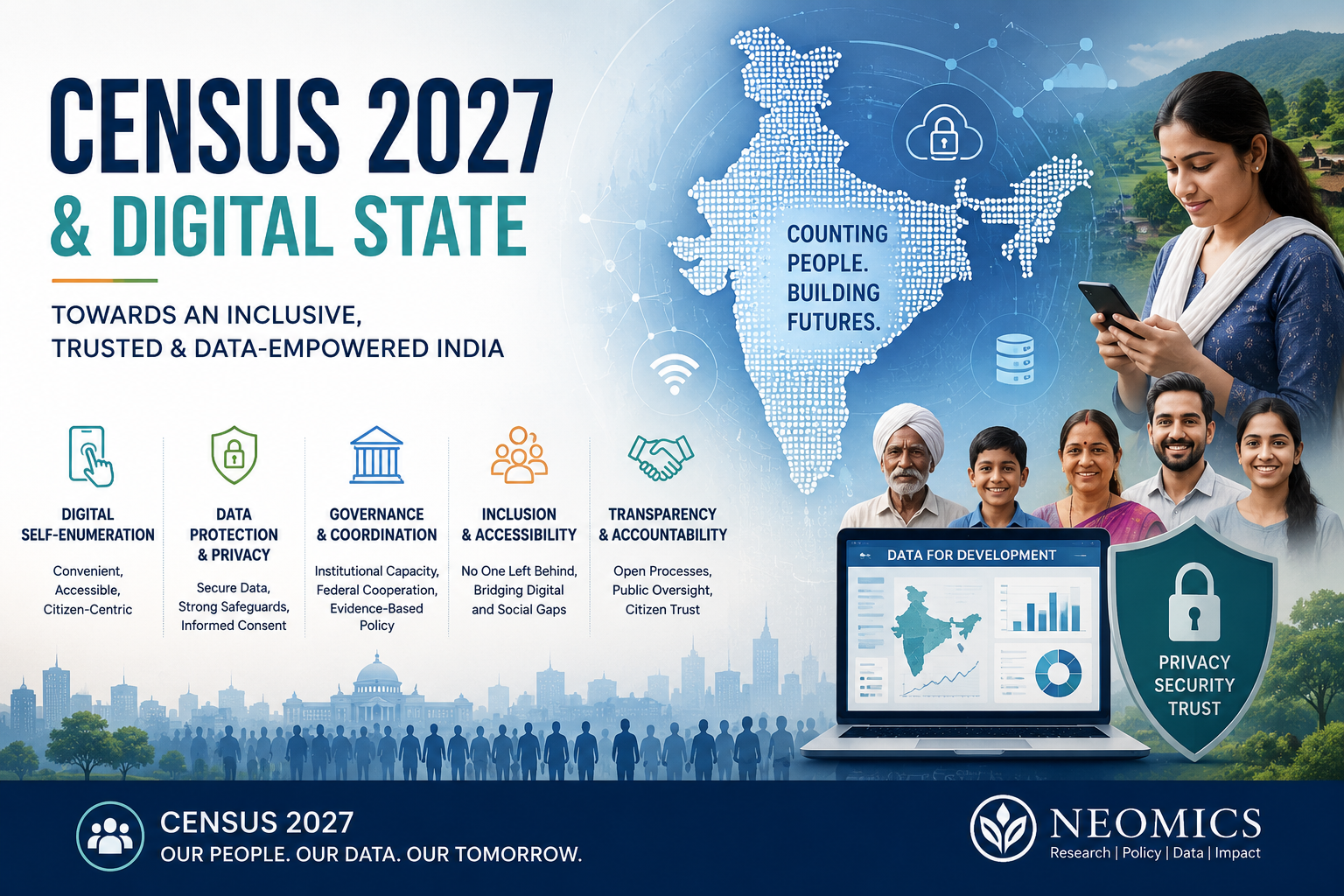
India’s 2027 Census marks an important transition toward a more digital approach to population enumeration. This research initiative examines digital self-enumeration, data protection, governance, privacy and public trust, with particular attention to the opportunities and institutional challenges created by a more technology-enabled census.
Why This Matters
India’s 2027 Census comes at a time when digital technologies are becoming increasingly integrated into public administration. Digital self-enumeration and technology-enabled data collection can improve efficiency, accessibility and the timely availability of population data. At the same time, they raise important questions about privacy, data protection, inclusion, institutional capacity and public trust. Understanding these opportunities and risks is essential to ensuring that digital transformation strengthens, rather than weakens, confidence in the census process.
Key Questions
How will digital self-enumeration change the way citizens participate in the Census?
What safeguards are needed to protect personal data and privacy throughout the census process?
How can digital systems improve efficiency without excluding people with limited digital access or connectivity?
What institutional and federal challenges could arise as India moves toward a more technology-enabled Census?
How can transparency, accountability and public communication strengthen trust in digitally enabled population enumeration?
Census 2027 Research Focus
This research examines the transition toward a more digitally enabled Census through the lenses of governance, privacy, inclusion, institutional capacity and public trust. It focuses on how digital self-enumeration and technology-enabled data systems can improve efficiency while addressing questions of accessibility, data protection, accountability and federal coordination.
Digital Self-Enumeration
The research examines how digital self-enumeration can improve convenience, coverage and administrative efficiency while considering digital literacy, connectivity and accessibility barriers.
Data Protection & Privacy
The focus includes data protection, privacy safeguards, responsible data governance and the institutional mechanisms required to protect citizens’ information throughout the census process.
Governance, Inclusion & Trust
The research considers federal coordination, institutional capacity, inclusion and public communication, with particular attention to building transparency and public trust in digitally enabled enumeration.
Evidence & Sources
This research draws on official Census documentation, government policy and regulatory frameworks, parliamentary and institutional sources, relevant academic research and publicly available evidence on digital governance, data protection and population enumeration.
Official Census & Government Sources
Official Census materials, government notifications, policy documents and institutional guidance provide the primary basis for examining India’s transition toward digitally enabled population enumeration, including the design and implementation of the 2027 Census.
Census of India — Digital Census & Self-Enumeration
Census 2027 — Population Enumeration Questionnaire
Data Protection & Digital Governance
The research considers India’s evolving data-protection and digital-governance framework, including privacy, responsible data handling, institutional accountability and safeguards relevant to large-scale public digital systems.
Digital Personal Data Protection Act, 2023
Digital Personal Data Protection Rules, 2025
Academic & Independent Research
Academic studies and independent research help place India’s digital census transition in a wider context, including questions of digital inclusion, public trust, technology adoption, governance and the social implications of data-driven public administration.
Digital Census and Application of Advanced Technologies in Census
Abhishek Jain & Varinder Kaur — Technology, Policy, and Inclusion (2023).
Population Foundation of India — Inclusive and Secure Approach to India’s First Digital Census
Research Outputs
Research Briefs
Concise research briefs will synthesise key evidence, findings and implications from the Census 2027 initiative for researchers, institutions and public-interest stakeholders.
Policy & Governance Analysis
Analytical outputs will examine the policy, governance, privacy, inclusion and institutional dimensions of digitally enabled population enumeration.
Data & Visual Insights
Where reliable data are available, Neomics will develop accessible visualisations, evidence summaries and analytical explainers to support informed public understanding.
Explore the Research
Explore Neomics research, analysis and evidence on governance, society, technology and public-interest challenges. Our work brings together independent thinking, reliable evidence and practical insights to support informed discussion and constructive action.